
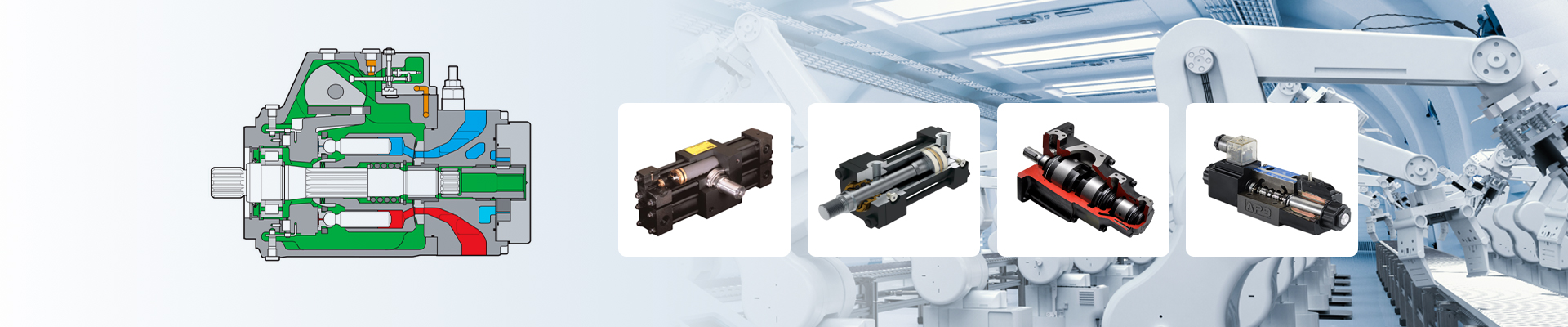
Basic Terminology of the Hydraulic Industry
Hydraulic Circuit: A part of a hydraulic device composed of various hydraulic components that has a specific function. Circuit Diagram: A hydraulic circuit diagram represented using hydraulic graphic symbols. Hydraulic Power Unit (Hydraulic Station): A hydraulic power source device consisting of a hydraulic pump, drive motor, tank, relief valve, etc., or a hydraulic device that includes control valves. Rated Pressure: The maximum pressure that can be used continuously. Back Pressure: The pressure acting on the return side of a hydraulic circuit or on the opposite side of a pressure-acting surface. Surge Pressure (Peak Pressure): The maximum value of rising pressure during a transient process. Cracking Pressure (Opening Pressure): The pressure at which a valve, such as a check valve or relief valve, begins to open and reach a certain flow rate as the pressure rises. Closing Pressure (Reseating Pressure): The pressure at which a valve, such as a check valve or relief valve, begins to close and the flow rate decreases below a specified value as the inlet pressure drops. Rated Flow: The guaranteed flow rate under specified conditions. Flow Rate: Generally refers to the volume of fluid output by a hydraulic pump per unit of time. Displacement: The volume of fluid output (or input) per revolution of a positive displacement hydraulic pump (or motor). Fluid Power: The power possessed by a fluid; for hydraulics, it is expressed as the product of flow rate and pressure. Conduit (Pipe Line): The pipes and piping system that convey the working fluid. Main Line: Includes the suction line, pressure line, and return line. Drain Line: Refers to the return line for drained fluid or the line that leads it to the reservoir. Passage (Channel): A channel within or inside a component, machined or cast, that conveys fluid. Port (Connection Port): The opening on a component where the fluid-conveying channel exits. Orifice (Throttle): A mechanism that reduces the cross-sectional area of flow, creating resistance inside a line or passage. Types include long-orifice throttles and thin-edge (sharp-edged) orifices. Spool Valve Element (Spool): A component that fits with a cylindrical sliding surface and opens or closes flow paths as it moves axially. Drainage (Case Drain / Leakage Drain): The fluid that is led from a passage (or pipe) inside a hydraulic component.
Special Terminology Glossary for Hydraulic Actuators
Hydraulic Pump: A pump used in a hydraulic system. Piston Pump: A pump in which pistons or plungers reciprocate under the action of a swash plate, cam, or crank, displacing fluid from the suction side to the discharge side. Positive Displacement Pump: A pump that displaces fluid from the inlet port to the outlet port by the movement or change in volume of a closed chamber formed by the housing and movable parts contained within it. Fixed Displacement Pump: A pump whose theoretical displacement per revolution is constant. Axial Piston Pump: A piston pump in which the reciprocating direction of the pistons or plungers is parallel to the axis of the cylinder block. Variable Displacement Pump: A pump whose displacement can be varied. Gear Pump: A pump that displaces fluid from the inlet port to the outlet port using two (or more) gears inside a housing. Radial Piston Pump: A piston pump in which the reciprocating direction of the pistons or plungers is perpendicular to the drive shaft axis. Vane Pump: A pump in which vanes inside a rotor slot contact the pump housing (stator ring), displacing the drawn-in fluid from the inlet side to the outlet side. Screw Pump: A pump that rotates a screw (rotor) inside a housing to displace oil from the suction side to the discharge side. Cushioned Cylinder: A hydraulic cylinder equipped with a cushioning function. Hydraulic Motor: An actuator used in a hydraulic circuit capable of continuous rotary motion. Fixed Displacement Motor: A hydraulic motor whose theoretical input displacement per revolution is constant. Positive Displacement Motor: An actuator that achieves continuous rotary motion due to the movement or change of closed chambers formed by movable parts inside a housing as fluid flows from the inlet port to the outlet port. Variable Displacement Motor: A hydraulic motor whose theoretical input displacement per revolution is variable. Gear Motor: A hydraulic motor that uses pressurized fluid to rotate two (or more) intermeshing gears inside a housing. Vane Motor: A hydraulic motor in which vanes inside a rotor slot contact the housing (stator ring), causing the rotor to rotate under the action of the incoming fluid. Piston Motor: A hydraulic motor where the pressure of the incoming fluid acts...
Hydraulic Valve Terminology and Explanations
Control Valve: A general term for valves that change the flow state to control pressure or flow rate. Pressure Control Valve: A general term for valves that control pressure. Flow Control Valve: A general term for valves that control flow rate. Directional Control Valve: A valve that controls the direction of flow. Sequence Valve: A valve that controls the operating sequence of actuators based on circuit pressure, etc., in systems with two or more branch circuits. Counterbalance Valve: A pressure control valve that maintains back pressure to prevent a load from falling. Pressure Reducing Valve: A pressure control valve that can reduce the outlet pressure to a value lower than the inlet pressure, independent of flow rate and inlet pressure. Unloading Valve: A valve that can unload the hydraulic pump under certain conditions. Throttle Valve: A valve that restricts fluid flow rate using the throttling effect. Typically refers to a flow control valve without pressure compensation. Flow Control Valve (Pressure Compensated): A flow control valve that maintains the set flow rate regardless of back pressure or pressure changes due to the load. Temperature Compensated Flow Control Valve: A flow control valve that maintains the set flow rate regardless of fluid temperature. Flow Divider Valve: A valve used to divide flow into two or more hydraulic lines, distributing the flow in a fixed proportion independent of the pressure in each line. Directional Valve: A directional control valve with two or more flow patterns and two or more ports. Lap (or Overlap): The overlapping state between the spool land and the port window in a spool valve; the corresponding value is called the lap amount (or overlap). Relief Valve: A pressure valve that, when the circuit pressure reaches the valve‘s set value, allows part or all of the fluid to return to the tank, maintaining the circuit pressure at that set value. Safety Valve: A valve used to limit the maximum pressure in a circuit to prevent damage to components and piping. Zero Lap: When the spool of a spool valve is in the neutral position, the ports are completely closed. As soon as the spool moves slightly, the port opens, allowing fluid to...
Mobile equipment hydraulic cylinder summer maintenance checklist


 18026559500
 1002702043